

Plastic
Honeycomb
Sheets
Incredibly Strong and Light Design from the Original Inventors
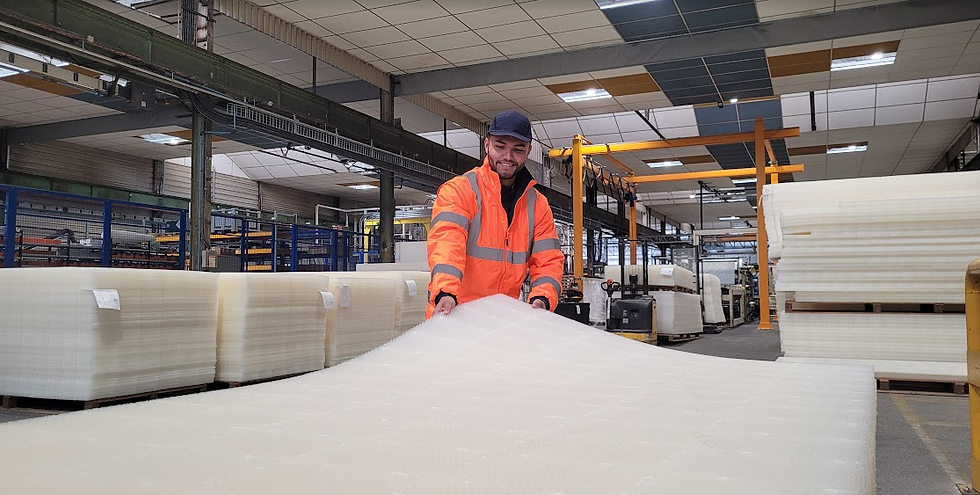
Plastic honeycomb is a lightweight composite core material made from extruded polypropylene formed into hexagonal cells and bonded with a non-woven polyester scrim. The result is a core with an exceptional strength-to-weight ratio that laminates easily with fiberglass, carbon fiber, and thermoplastic skins to produce structurally advanced sandwich panels.
CEM supplies Nida-Core, the original plastic honeycomb developed by Nidaplast more than 40 years ago and the benchmark PP honeycomb in marine, transportation, construction, and stormwater management. Unlike the generic "straw technology" honeycomb flooding the market, Nida-Core is produced from a co-polymer blend that delivers consistent performance across a broader temperature range and maintains its mechanical properties in long-term service.
What is Plastic Honeycomb?
Plastic honeycomb is the core material used in the middle layer of composite sandwich panels. The honeycomb structure — 8mm hexagonal cells extruded from polypropylene — provides high compressive and shear strength at a fraction of the weight of solid material. A plastic film seals each cell to prevent resin intrusion during lamination, and a thermofused polyester non-woven scrim on both faces creates an ideal bonding surface for fiberglass, carbon fiber, or thermoplastic skins.
Compared to traditional core materials like plywood, balsa, and PVC foam, plastic honeycomb offers:
-
Superior strength-to-weight ratio
-
Zero water absorption — no rot, no corrosion, no waterlogging
-
Excellent chemical and solvent resistance
-
High sound and vibration dampening
-
100% recyclable polypropylene construction

Three Types of Honeycomb Sheets
The standard PP honeycomb core. General-purpose strength and lightness for marine, construction, and industrial sandwich panel applications. Compressive strength 174 psi, shear strength 58 psi.
Nidaplast 8
Nidaplast 8FR
Fire-retardant variant with UL94 V2 classification. Used where finished sandwich panels need to meet M1/F0 fire performance ratings. Mechanical properties match the standard 8.
Nidaplast 8HP
High-performance variant with more than 2x the compressive strength of standard 8 (377 psi) and roughly 75% higher compressive modulus. Used for structural applications and higher load paths where weight savings still matter.
*All three variants share identical cell geometry, sheet dimensions, and scrim construction — the performance difference is in the polypropylene formulation.
The Original
Plastic
Honeycomb
Technical Specifications
Property
Test Method
Nidaplast 8
Nidaplast 8FR
Nidaplast 8HP
Compressive Strength
ISO 844
174 psi/1.2 MPa
174 psi/1.2 MPa
377 psi/2.6 MPa
Compressive Modulus
ISO 844
5,801 psi/40 MPa
5,801 psi/40 MPa
10,152 psi/70 MPa
Perpendicular Tensile Strength
ASTM C297
116 psi/0.8 MPa
116 psi/0.8 MPa
116 psi/0.8 MPa
Shear Strength
ISO 1922
58 psi/0.4 MPa
58 psi/0.4 MPa
101 psi/0.7 MPa
Shear Modulus
ISO 1922
1,305 psi/9 MPa
1,305 psi/9 MPa
2,030 psi/14 MPa
Water Resistance
ASTM C393
~100%
~100%
~100%
Heat Resistance (20mm core)
-
R=0.3 m²·°C/W
R=0.3 m²·°C/W
R=0.3 m²·°C/W
Heat Resistance (90mm core)
-
R=0.6 m²·°C/W
R=0.6 m²·°C/W
R=0.6 m²·°C/W
Fire Classification
-
Inflammable; M1/FO with compliant skins
UL94 V2
Inflammable; M1/FO with compliant skins
Chemical Resistance
-
Resistant to water, most acids, bases, salt solutions
Resistant to water, most acids, bases, salt solutions
Resistant to water, most acids, bases, salt solutions
*All values measured at 68°F. Data applies to the core material; finished sandwich panel performance depends on skin selection. See the Nidaplast 8 Technical Data Sheet (PDF) for full test results.
Engineered for Performance
With 40 years of innovation, our Nida-Core Honeycomb has acquired an array of benefits suited for a multitude of industries. Key features include compression strength, sound dampening, water/fire/chemical resistance, and long-lasting durability.

The co-polymer polypropylene formulation is what differentiates Nidaplast from generic mono-polymer honeycomb. Co-polymer PP resists a wider temperature range — from sub-freezing storage through sustained heat exposure — without dimensional change or cell collapse. That's why Nida-Core has remained the reference standard for marine manufacturers since the 1980s.
Custom Orders
Our plastic honeycomb offers versatile customization options to meet a wide range of structural and design needs. Available in sheet sizes of 4'x7' and 4'x8', our Nida-Core Honeycomb can be tailored in thicknesses ranging from 5mm to 100mm, providing flexibility for both lightweight and heavy-duty applications. These honeycomb sheets can be used as core materials in composite sandwich panels, where your preferred size and thickness are easily integrated to optimize strength, stiffness, and weight reduction.
Frequently Asked Questions:
-
What thickness of plastic honeycomb should I use?
Thickness selection depends on span, expected load, and skin materials. Thin cores (5–10mm) work for lightweight panels and signage. Mid-range cores (12–25mm) are standard in marine stringers and interior partitions. Thick cores (40–100mm) are used where stiffness matters more than weight, like RV floors and structural walls.
-
Can plastic honeycomb be laminated with polyester resin?
Yes. The polyester non-woven scrim and sealed cell film are specifically designed for low-resin-absorption lamination with polyester, vinyl ester, and epoxy. Typical resin absorption is less than 1% by volume, versus 20–30% for open-cell foams.
-
Is Nida-Core fire-rated?
Standard Nidaplast 8 is inflammable and can achieve M1/F0 classification when laminated into finished panels, depending on skin choice. For applications requiring a core-level fire rating, specify Nidaplast 8FR, which is UL94 V2 classified.
-
Is plastic honeycomb recyclable?
Yes. Nidaplast honeycomb is produced from excess polypropylene and is 100% recyclable, contributing to the sustainability profile of any finished composite panel.
-
Do you offer custom sizes and thicknesses?
Yes. While 4'x7' and 4'x8' sheets in 5mm–100mm thicknesses are standard, CEM manufactures Nida-Core to custom specifications. Contact us for a quote.
-
How does Nida-Core compare to Chinese straw honeycomb?
Straw technology honeycomb is produced from mono-polymer polypropylene extruded as tubes and stood on end. Nida-Core is extruded as a true hexagonal honeycomb from a co-polymer blend, which yields more consistent cell geometry and better thermal and mechanical stability. In service applications exposed to heat cycling or flexural load, the difference shows up as delamination and cell collapse in the mono-polymer products.